Tournament of Champions
Rodney Hampton
- 11 minutes read - 2269 wordsOn August 16th we staged a jousting tournament using Chainmail 3rd edition. We also tried out my 1 page jousting rules from Midwest Fantasy Wargame (based on Don Featherstone’s Solo Wargaming rules)
Prelude
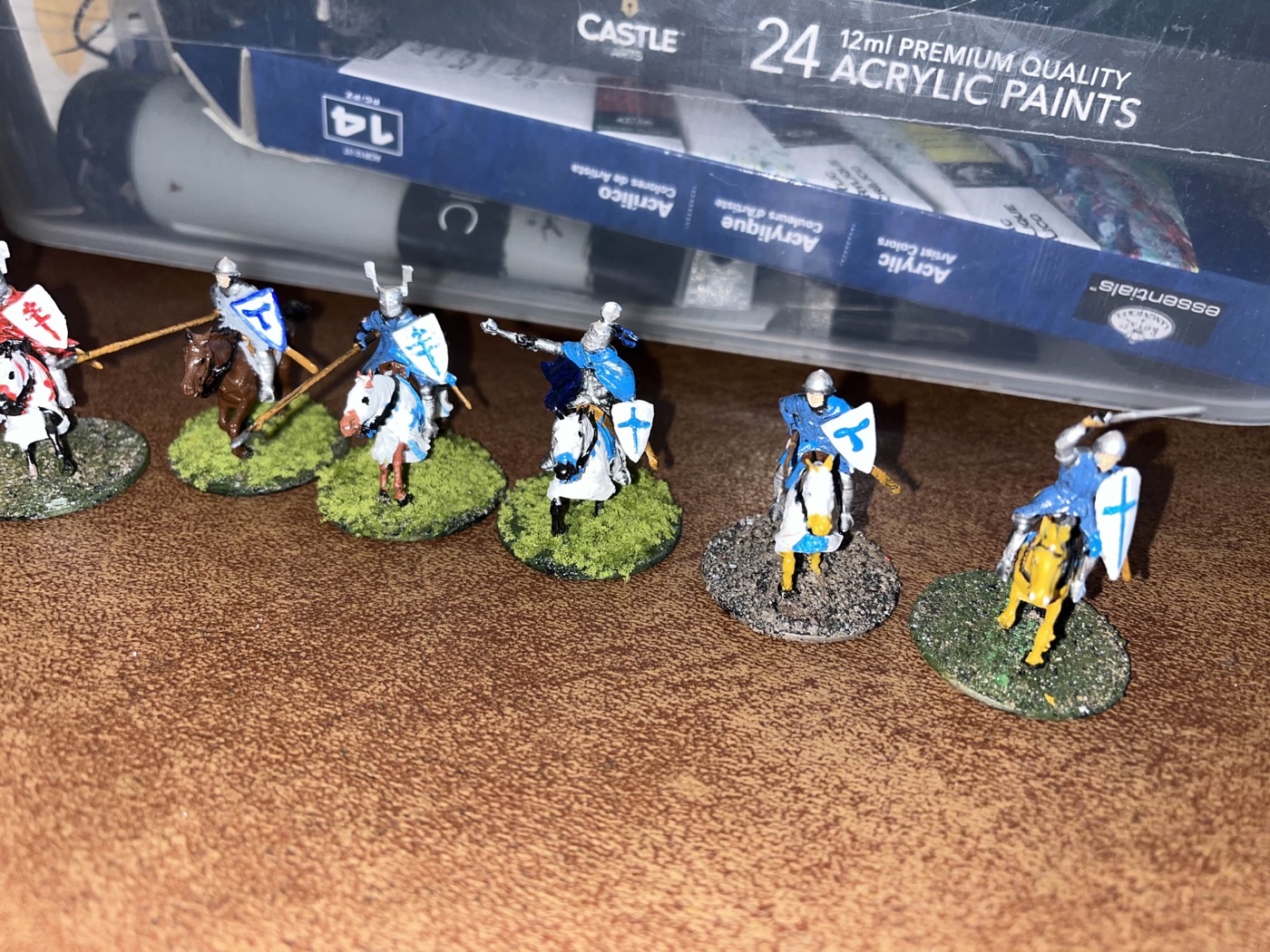
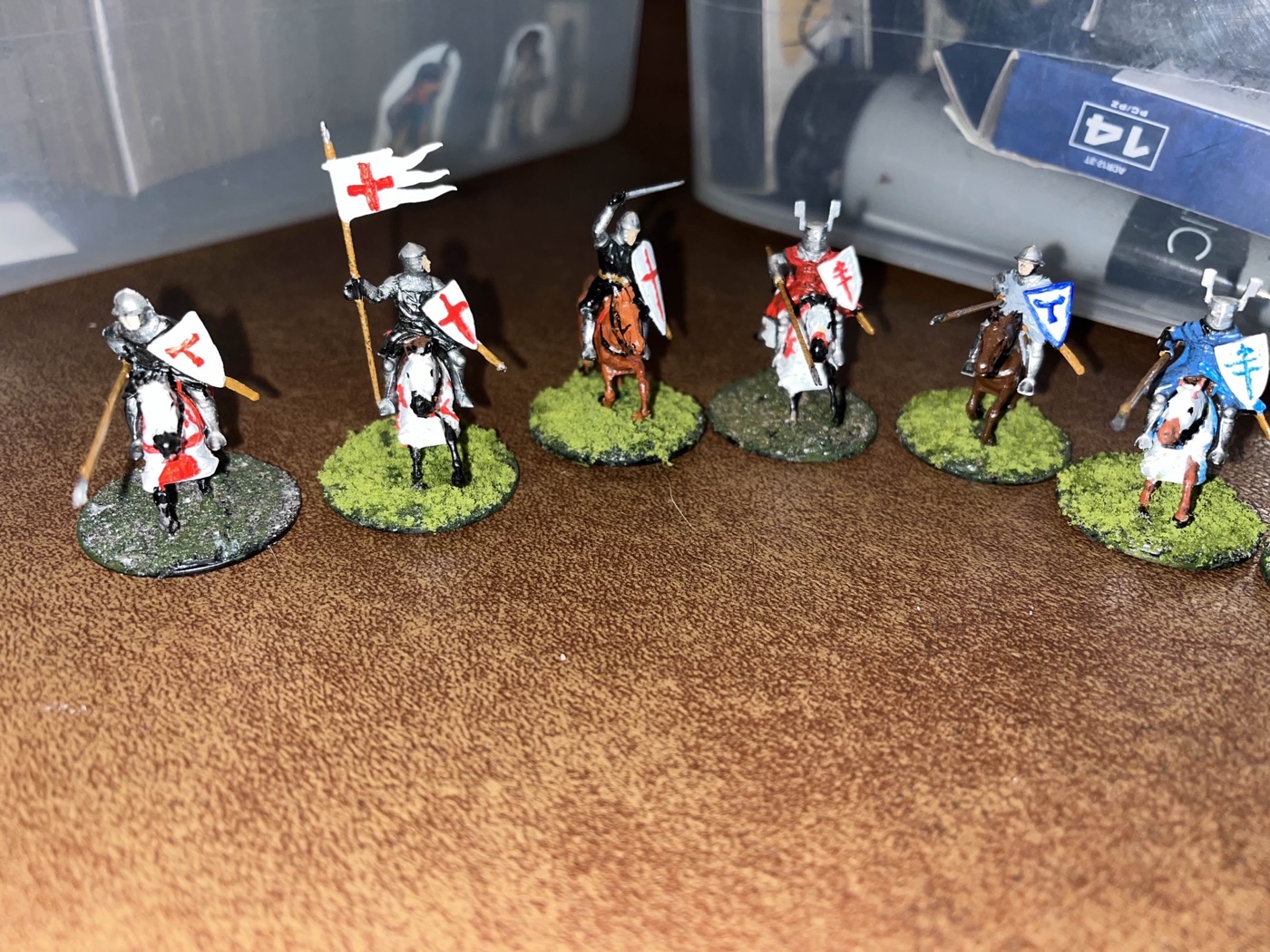
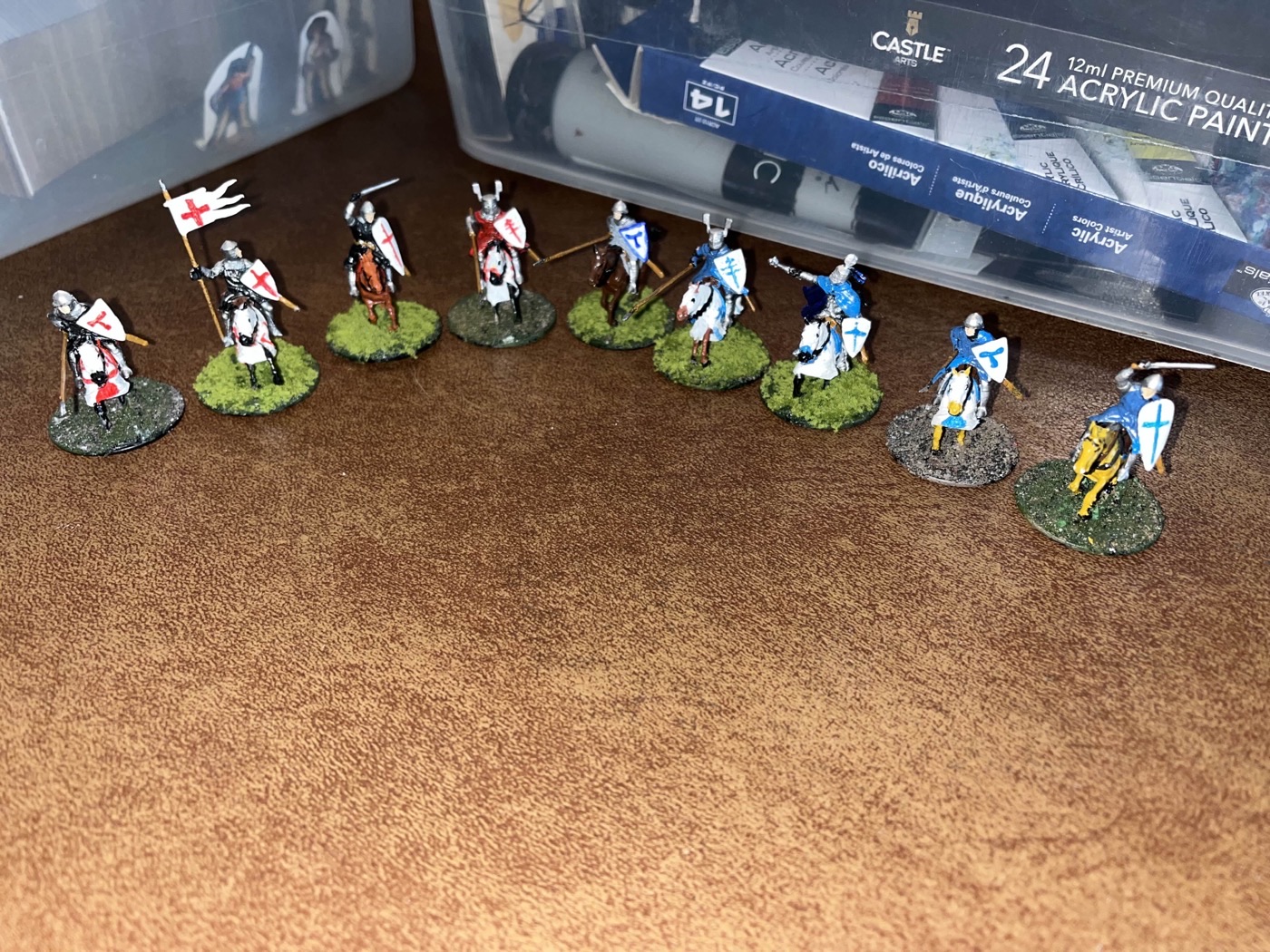
When I announced this tournament on Discord, I had these miniatures half completed. With some touch ups, some flock, and a bit of patience I was able to put them in enough order to ensure some pageantry.
Miniature Wargaming - How Much Does It Cost?
Incidentally, I use mostly Castle Acrylic paints on my minis. They currently retail for $35. If I ever exhaust these tubes, I feel like I am qualified to bump up to speed paints. I use a set of relatively cheap goat-hair brushes — Transon Round Watercolor Paint Brush 8 piece set — bought on Amazon for $10. The bases are zinc 1” fender washers that I bought off Amazon in a box of 100 for $22.93 (with shipping). I just clicked Buy Now since these are now only $15 with shipping! I use Krylon rattle cans to prime my minis in white, grey, black, or light olive. Those cans are $8 each. The matte black is considered both paint and primer. Some of these have model railroad flock, the rest were just playground sand. I have a big jug of PVA glue (basically Elmer’s) and Gorilla Clear Super Glue XL ($7.50 per bottle. I buy what I can via Lowes and use my military discount. The minis below are 1/72 scale Livonian Knights from Zvezda that I bought on ebay. The price was $11.99 for a box of 33 miniatures and with shipping it was $18.92 (57 cents per mini). All told, you can get started in miniature wargaming (with enough figures for a skirmish) for $120 if you shop wisely. It does not have to be an expensive (dollar-wise) hobby.
Note: Learning to paint such small figures has been a struggle for me. I don’t think I could do 15mm or 10mm figures.
To the Lists!
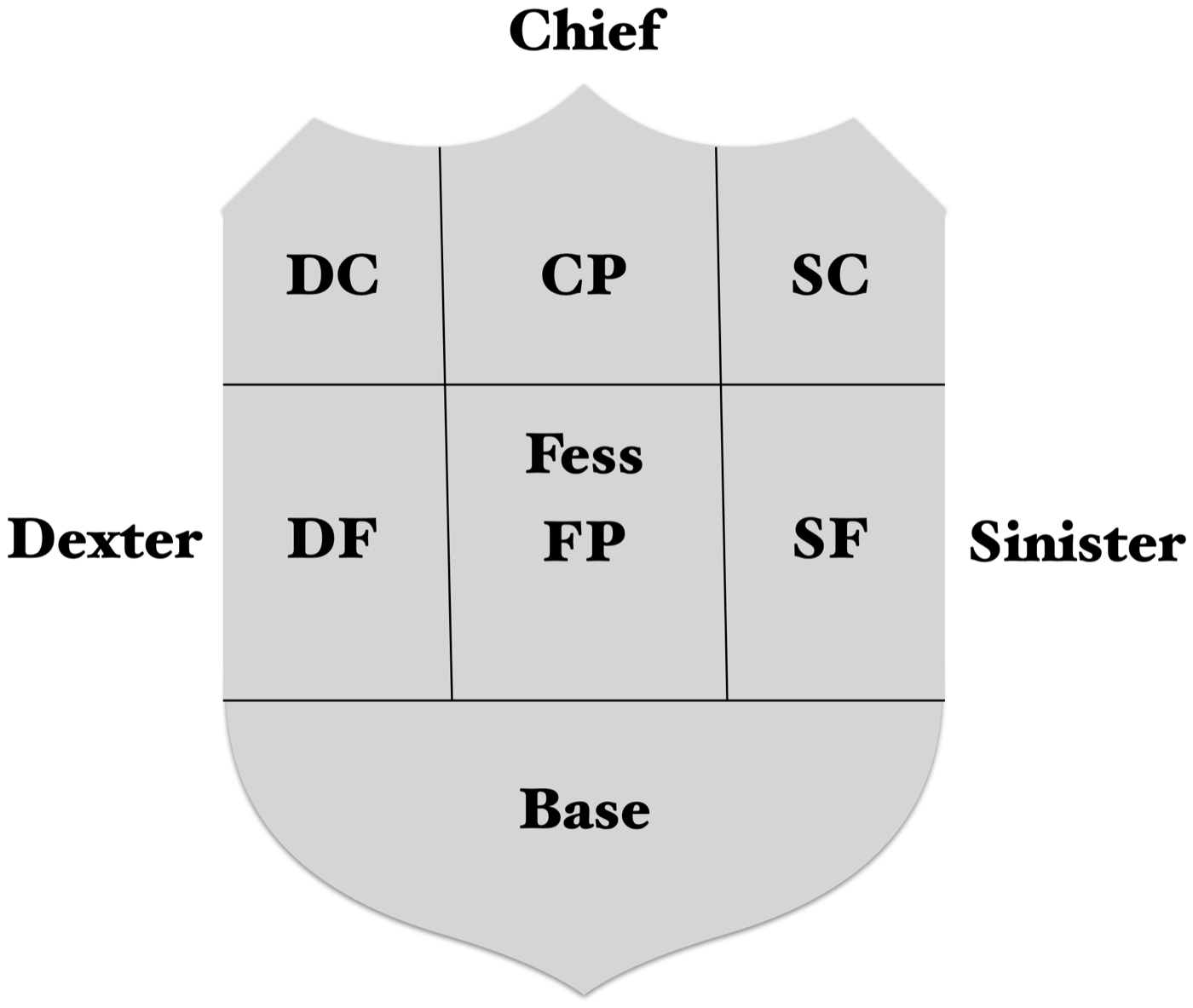
Chainmail uses a simple table. Basically each side picks an aiming point and a defensive posture. Results are simultaneous. The point scoring system is a bit wonky: -1 for breaking your own lance, -10 points for getting injured, 3 points for knocking your opponent’s helm off, and 20 points for unhorsing your opponent. This scoring rubric is for teams, but also can be used to compare the results for individual riders.
The aiming point is based on the configuration of a medieval shield (for heraldry).
The Participants
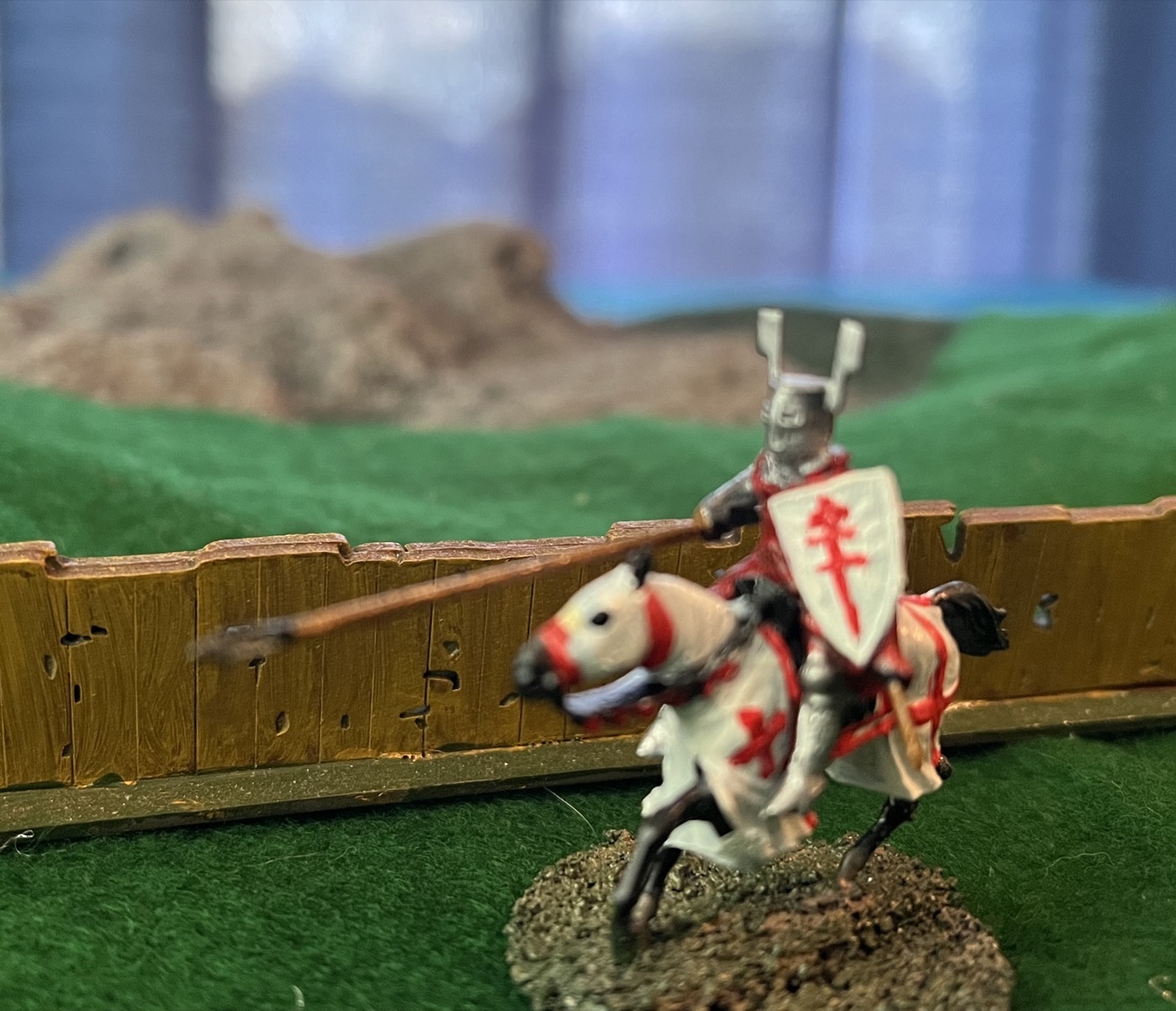
The Midnight Champion - bearing a red and white shield and wearing a winged great helm - (hoot)
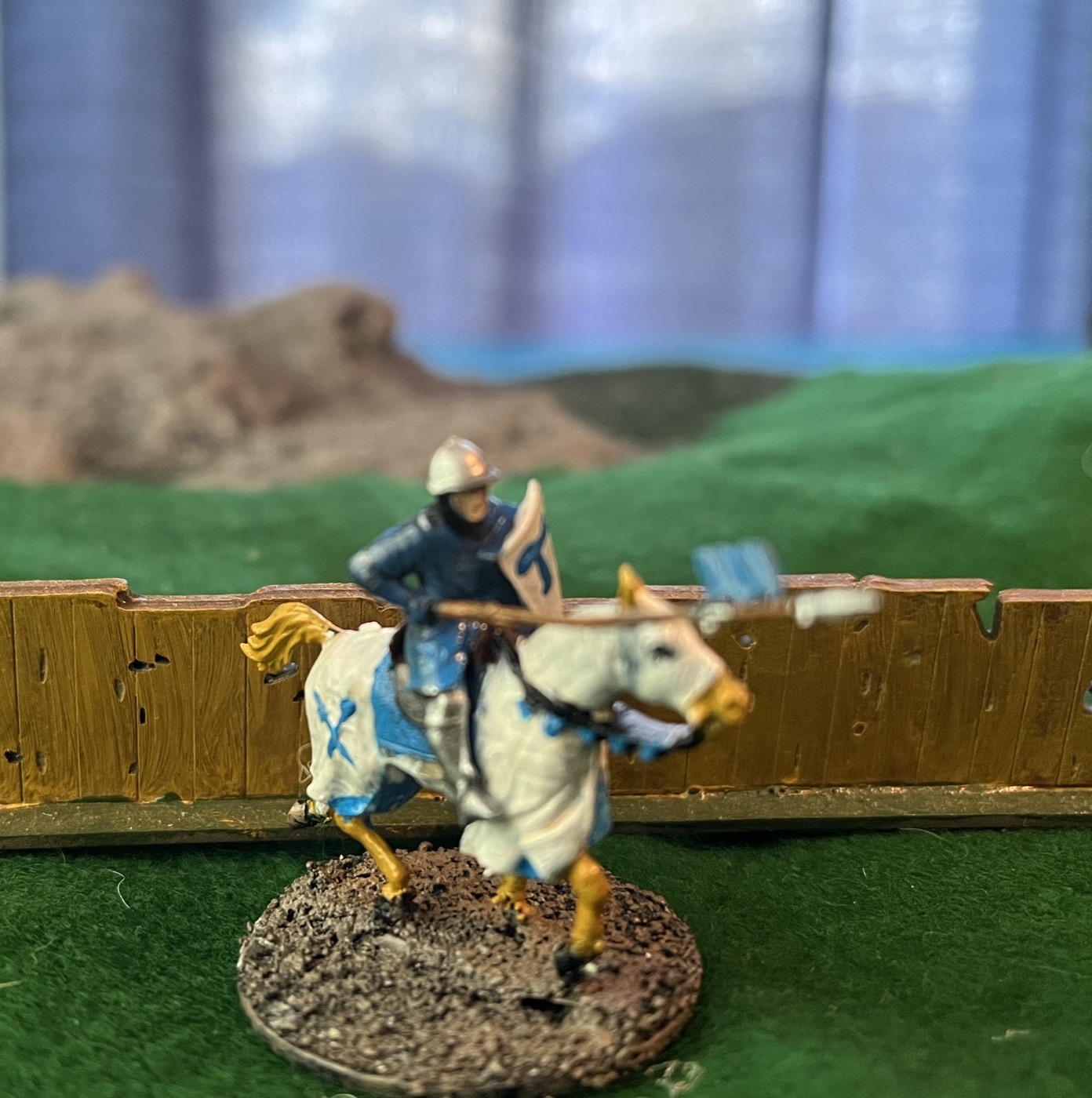
Sir Bolkoff of Arimanth - whose lance is adorned with a blue pennant - (snufkin)
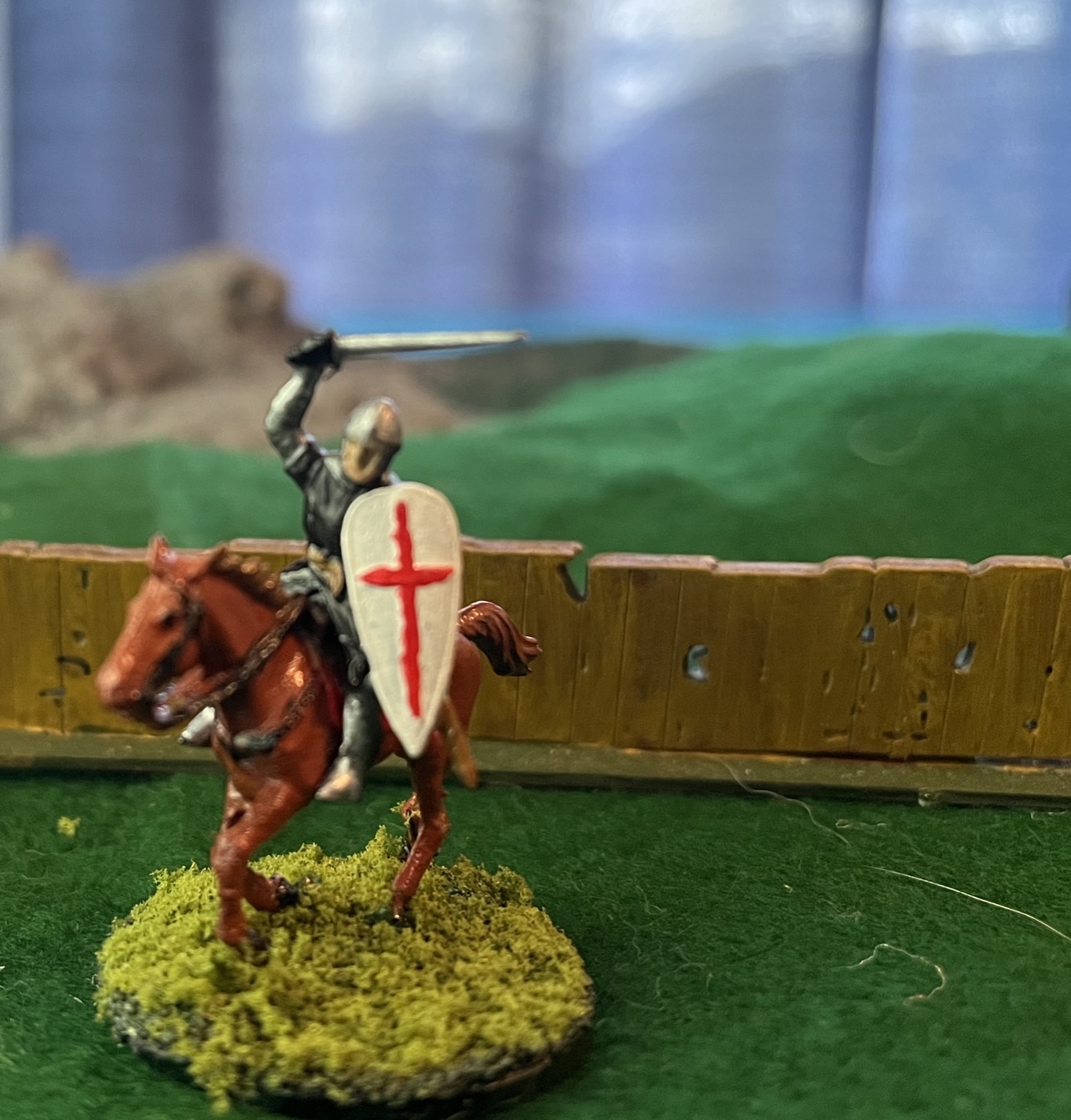
Bertrand du Guesclin, “connétable de France” wearing the black tabard and riding upon a sorrel mare without caparison - (java)
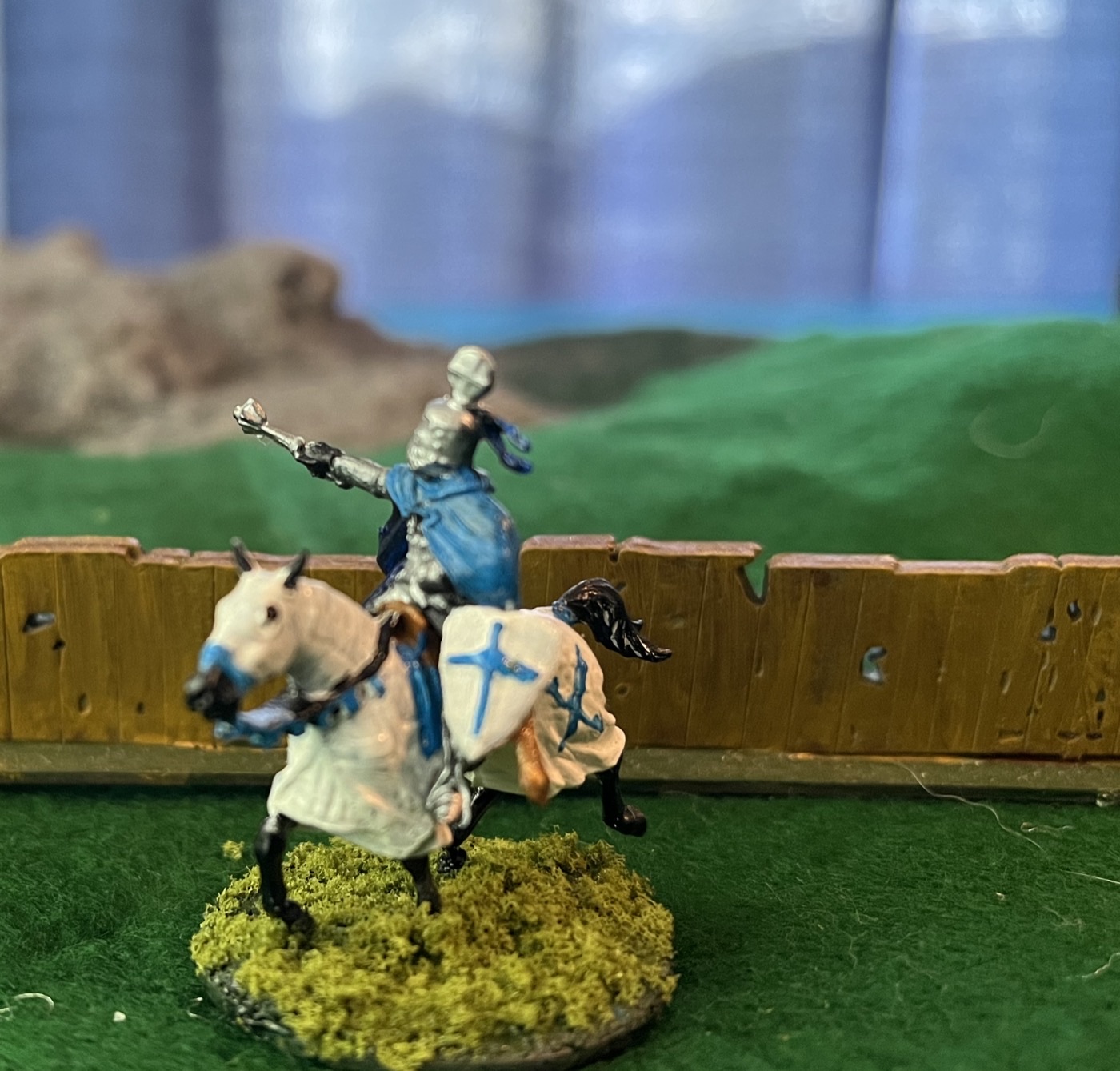
Vilain de Nully - bearing a mace as befitting his position within the Church militant and whose crest reminds us of cross of our Lord and Savior - (forest)
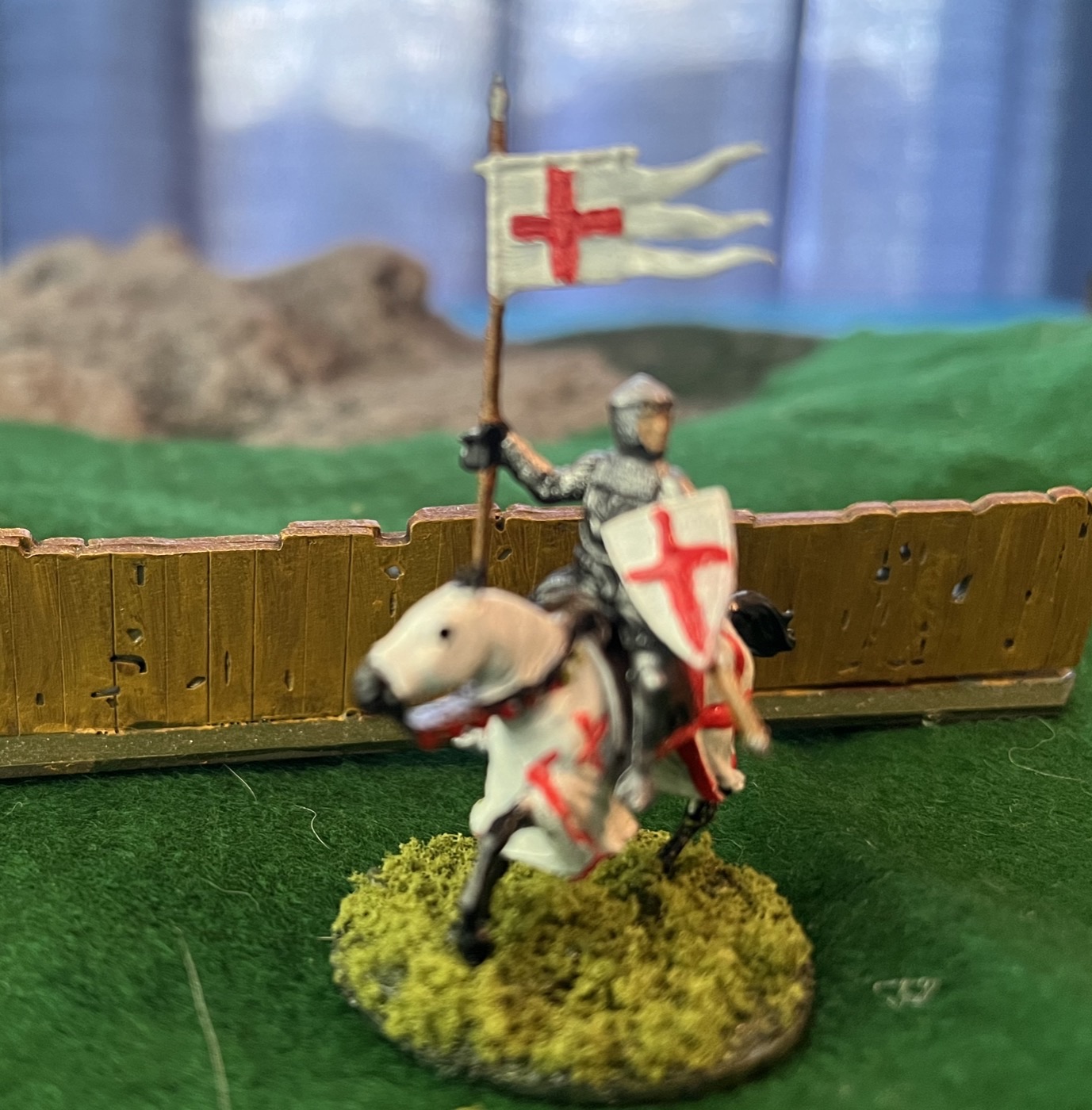
Sir Galiant - bearing the standard of the Knights Templar - (hatlessAsh)
The Jousts
1st Match - Bertrand du Guesclin versus The Midnight Champion
BdG: Fess Pale - Shield Low
TMC: Chief Pale, Lean Left
Bertrand du Guesclin breaks his lance. He is also unhorsed and injured by The Midnight Champion. Because one of the riders has been unhorsed, this jousting match is over, but what does “injured” mean? Chainmail is silent so we must fill the gap. Much like I have done in Dragons Beyond, the injury will sideline a particular participant for a number of “rounds” of jousting. I roll 1d3 - getting 2. BdG may return to the tournament after 2 rounds of jousting.
2nd Match - Sir Bolkoff versus The Midnight Champion
SB: Dexter Fess ->Steady seat
TMC: Fess Pale, Steady Seat
Sir Bolkoff breaks his lance. The Midnight Champion also breaks his lance, however he has unhorsed Sir Bolkoff and wins the match.
3rd Match - Vilain de Nully versus The Midnight Champion
VdN: Chief Pale, Lean Left
TMC: Base of Shield, Lower Helm
Vilain de Nully breaks his lance, unhorsing and injuring The Midnight Champion. However, the Midnight Champion has also unhorsed him. The match is ended and I roll 1d3 - getting 2. The Midnight Champion is out of action for a bit.
4th Match - Bertrand du Guesclin versus Vilain de Nully
BdG: Fess Pale, Lean Left
VdN: Sinister Fess, Steady Seat
Bertrand du Guesclin has broken his lance and unhorsed Vilain de Nully. However, Vilain has done the same to him! Ever the pundit, Vilain de Nully mutters, “It’s raining knights out here!”
5th Match - Sir Bolkoff versus Vilain de Nully
SB: Base, Shield Low
VdN: Chief Pale, Lean Left
Sir Bolkoff unhorses Vilain de Nully, and Vilain has unhorsed and injured Sir Bolkoff in return. I roll 1d3 - putting Sir Bolkoff out of action for 2 rounds. Due to the way the brackets work, however, the tournament is suspended until Sir Bolkoff can proceed.
6th Match - Sir Bolkoff versus Bertrand du Guesclin
SB: Fess pale, lower helm
BdG: Chief Pale, Steady Seat
Sir Bolkoff breaks his lance and unhorses Bertrand. Bertrand breaks his lance, and unhorses and injures Sir Bolkoff. I roll 1d3 and Bolkoff is merely winded for a round.
7th Match - Sir Galiant (a late arrival) - versus Vilain de Nully
This was the first time we had multiple rounds of jousting, along with our first error.
SG: Dexter Chief, Shield High
VdN: Sinister Fess, Shield Low
Sir Galiant misses on his first pass and Vilain’s lance glances aside. Both will ride again.
SG: Pale fess/ steady seat
VdN: Dexter Chief, Lean Left
Sir Galiant breaks his lance. So does Vilain.
SG: Chief pale/ shield low
VdN: Chief Pale, Shield Low
Both riders assume exactly the same posture which unhorses and injures the other.
I roll 1d3 twice - getting 1 for Sir Galiant and another 1 for Vilain. In terms of points, both riders get 20 points less 10 for receiving an injury resulting in 10 points for each.
During the third round both riders should have both been forced to ride with a Steady Seat. Likely, both would have also aimed Fess Pale and scored 19 each. We decided not to retcon or redo the joust.
8th Match - Sir Galiant versus Bertrand du Guesclin
SG: Fess pale/ shield high
BdG: Sinister Chief, Steady Seat
Sir Galiant breaks his lance while unhorsing Bertrand. Bertrand’s lance glances off.
9th Match - Sir Galiant versus Sir Bolkoff of Arimanth
SG: Chief pale/ lean left
SB: Chief pale, Lean Right
Both riders are unhorsed.
After this match, the crowd begins to murmur, they can see that The Midnight Champion has been summoned back to the lists. Speculation and debate about the current standings become intense as the riders make ready.
10th Match - Sir Galiant versus The Midnight Champion
SG: Dexter chief/ shield low
TMC: Chief Pale, Lean Left
Sir Galiant misses as he is unhorsed and injured. This was a huge upset. The crowd goes wild. Rumors circulate that Sir Galiant may have been paid to take a tumble. The Midnight Champion calls out to Vilain de Nully as he leaves field: “Good tilting, sir!” Vilain de Nully growls under his breath, “Oh, I’m tilted alright” but The Midnight Champion does not hear him over the crowd.
Winners and Losers
Finally, the Herald proclaims the results: “The Midnight Campion is overall judged the best rider, however, team Blue is awarded the winning result.”
Sir Bolkoff of Arimanth (blue) - 17
Vilain de Nully (blue) - 66
Team Blue: 83
Bertrand du Guesclin (red) - 27
Sir Galiant (red) - 37
The Midnight Champion (red) - 69
Team Red (worst): 64
Team Red (best): 106
Sir Galiant and Bertrand du Guesclin are particularly offended by this ding to their honor and refuse to surrender their armor as was customary for the losers. Harsh words are exchanged between The Midnight Champion and Vilain de Nully. The men cannot be curbed and decided to fight another set of jousts with un-blunted lances. These rides, in earnest, would determine the true winner as if it were a series of trials by combat.
New Rules
We switched to using the one page jousting rules that I had developed for Midwest Fantasy Wargame: The Primeval RPG. These rules were built upon those outlined by Don Featherstone in his book on Solo Wargaming.
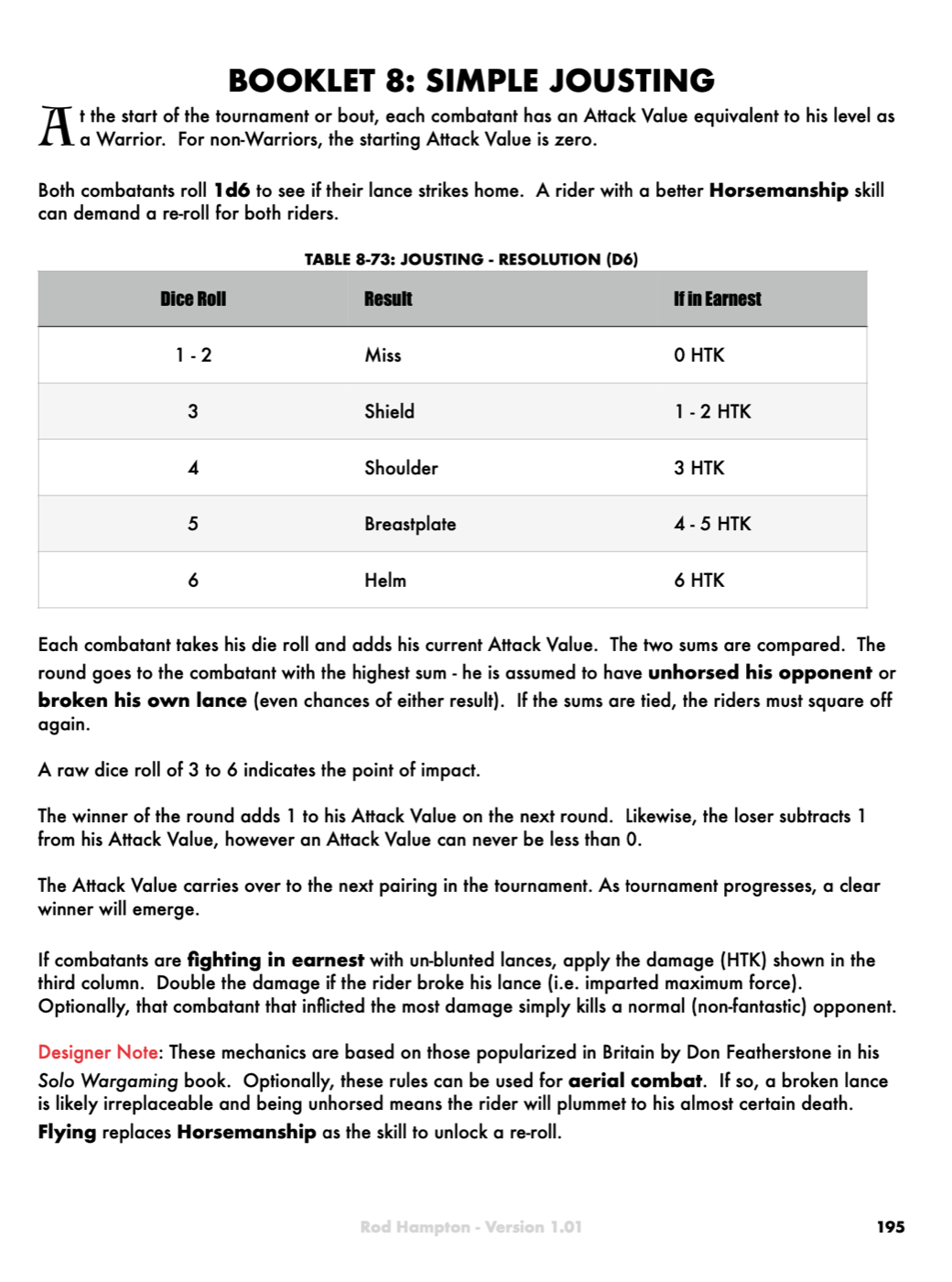
I ruled that all of the participants were 1st level Fighting Men (aka Warriors in Arneson’s pre-D&D Blackmoor campaign). This gave each of them a +1 as their initial Attack Value. We rolled the horsemanship skill for each rider using 2d6. Again, these matches the skill system used by Arneson as shown on the Spanish Royals character sheet preserved by Daniel Nicholson. Finally, we rolled hit points (Hits To Kill or HTK) using the standard 1d6+1. Here are the results:
- Bertrand du Guesclin: 5 HP, Horsemanship 10
- The Midnight Champion: 4 HP, Horsemanship 9
- Sir Bolkoff of Arimanth: 2 HP, Horsemanship 8
- Vilain de Nully: 7 HP, Horsemanship 6
- Sir Galiant: 2 HP, Horsemanship 5
As one of the players pointed out, really the only tactical choice here is whether to force the re-roll and that choice is limited to the rider with the best horsemanship.
“The decision to re-roll is a pretty good mechanic, in that it gives a good chance of success, but still allows for bad luck to best the higher-rated opponent. As the 2nd-lowest rated opponent, I had no decisions to make, though.”
Match 1 - Sir Bolkoff of Arimanth versus Sir Galiant
The first match is between riders with the least amount of hit points. Bolkoff represents blue and Galiant, red.
SB: raw roll 4, total 5
SG: raw roll 3, total 4
Sir Bolkoff strikes Sir Galiant’s shoulder inflicting 3 points of damage. Sir Galiant hits Bolkoff’s shield and he must take 1-2 points of damage. The winner is Sir Bolkoff. I roll to see if he either unhorsed his opponent or broke his lance. The result is a broken lance that imparts double the normal damage. Thus, Sir Galiant suffers 6 points of damage and dies. Sir Bolkoff, unfortunately, receives 2 points of damage and also dies.
Match 2 - Bertrand du Guesclin versus Vilain de Nully
Another match up of red (Bertrand) versus blue (Vilain).
BdG: raw roll 1, total 2
VdN: raw roll 1, total 2
Both miss. Because the riders are tied (even when considering their attack value), they must square off again.
BdG: raw roll 4, total 5
VdN: raw roll 2, total 3
Vilain misses. Bertrand wins. He unhorses Vilain by striking him in the shoulder for 3 points of damage. Vilain is down to 2 hit points. The Midnight Champion called out from the sideline to Vilain de Nully encouraging him to “Yield!” Yet he does not.
BdG: raw roll 4, total 6 (since his Attack Value increased to two)
VdN: raw roll 6, total 6 (since his Attack Value decreased to zero)
Bertrand strikes Vilain in the shoulder doing 3 points of damage (he was down to 2). Vilain strikes Bertrand in the helm doing 6 points of damage (he only had 5). Both combatants die!
The Midnight Champion o’er looked the field. Four dead knights felled for the sake of honor. There was, however, no longer any doubt. The Midnight Champion was the undisputed winner both as an individual and the sole remaining representative of his team.
Other Jousting Rules
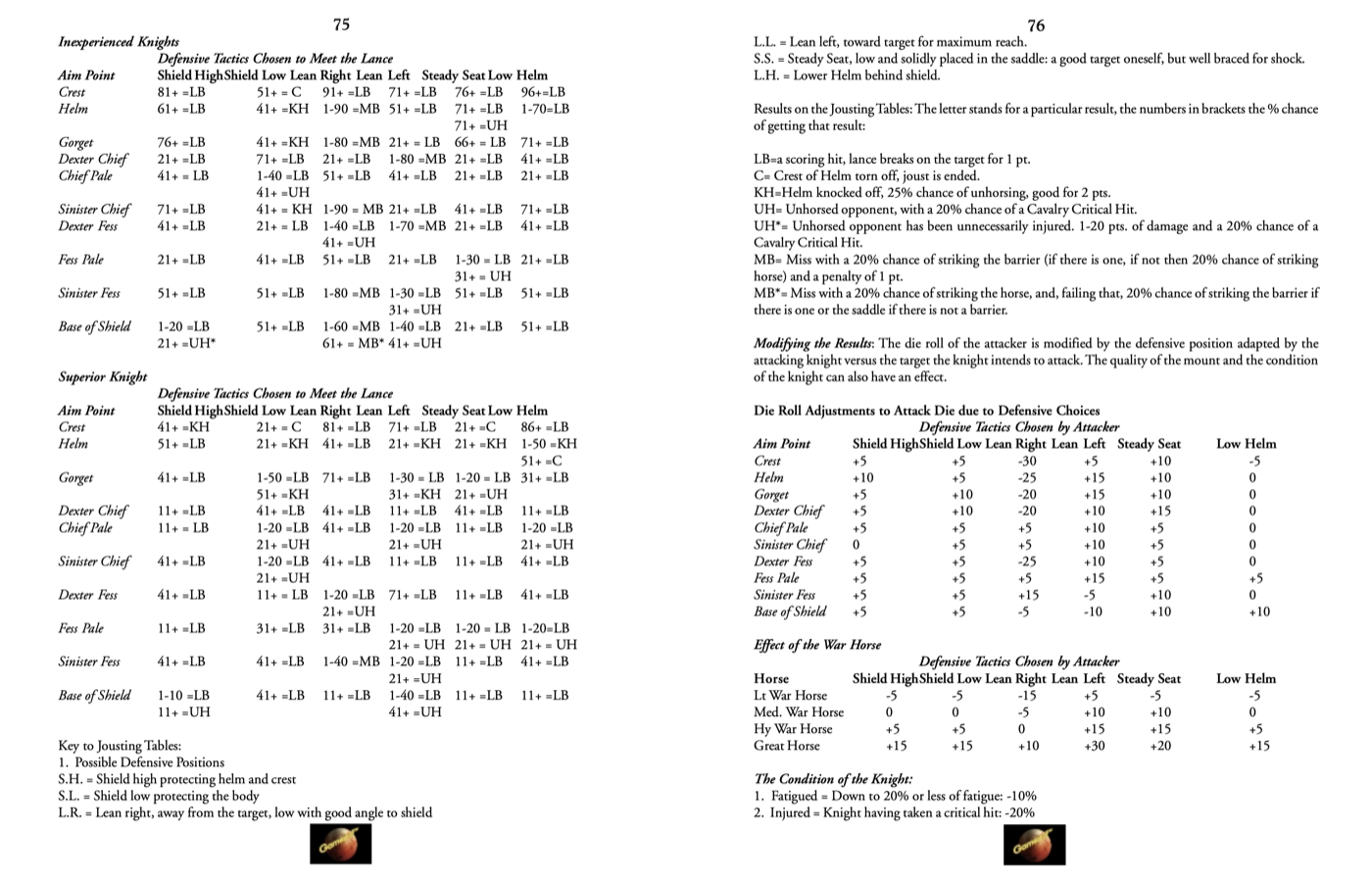
The Chivalry and Sorcery 1st edition (red book) has a fairly complex, percentage based jousting system. The original was published in 1978, but Gamestuff Inc. republished it in 2000. Here is a portion of it for commentary, criticism, scholarship, etc.
Full Tilt: Tournaments in the Kingdom of Brettonia is another alternative. A few play throughs are available on YouTube.
The Tourney: A Medieval Game by Stephen A Turner (I think I found this on facebook)
Alchemical Raker has restated the Chainmail rules in The Old Lords of Wonder and Ruin. Some may prefer his restatement to the original.
There are also jousting rules in my own Dragons Beyond which try to thread the needle between Chivalry and Sorcery and Chainmail. I have also addressed the shortcomings with Chainmail’s jousting rules (keep reading).
Lessons Learned
Chainmail has four shortcomings. First, there is no definition of what happens when a rider is injured. As mentioned above, we simply rolled 1d3 to determine for how many jousting rounds the injured knight would be sidelined. Second, where multiple results are indicated such as B/U, B/U/I, or U/I there is no text that says that these are combined results or else alternate results that should be picked at random. There is a tradition of treating them as combined results, however so we stuck with that. Third, when forced into position 4, there is a definite way to game the system. Finally, Delta (Dan Collins) has already analyzed Chainmail and found that there are certain choices which are mathematically advantageous. A cursory study of the jousting table shows that aiming for the helm will likely result in a Miss.
Post Script
For those who prefer to watch the entire play through, I did manage to get the YouTube livestream to post without interfering with my ability to stream to the participants at the same time on Discord. Unfortunately, as I was doing some cleanup on other unsuccessful streams a few minutes ago, I deleted it!!!! F-me.
Originally published on Substack on September 1, 2025.