The Robot is the Key
Rodney Hampton
- 6 minutes read - 1180 wordsDiscerning Dave Arneson’s Blackmoor Combat System - Part 1
Warning! Warning! We are entering on an area of speculation driven by an urgent need to understand the combat system Dave Arneson used in early Blackmoor. It was not Chainmail, but it had aspects borrowed from Chainmail. It was most assuredly not derived from the complex Kriegspiel —> Totten Strategos —> Strategos A(ncients) lineage, though it borrowed concepts from there as well. It also borrowed from the Fletcher Pratt naval wargame —> unnamed ACW game —> ?“Damn the Torpedoes!”? lineage. It is an amalgamation. This 4 part series will give you my best guess at how it operated. It seems quite simple in retrospect. But I’ve been at this for a while.

The most recent clue comes from looking at Arneson’s First Fantasy Game (FFC), this time loading an old scan into Claude piecemeal and having it do some analysis of the text. This is not perfect. The scan that I have is based on embedded images and a LOT got jumbled in the OCR conversion to text. But enough valid info poured through for Claude to do its thing.
Here I must point out that the doctrine of Fair Use allows for the use of excepts of text for criticism, news reporting, teaching, and research . . . or at least that’s what the internet says. :-D
Claude responded to my query about the types of armor in First Fantasy campaign by pointing out that there is no padded, ring, banded, splint, lamellar, scale, or studded leather in FFC. There are shields, helms, plate, chainmail, and leather armor only.

What’s more interesting was an additional tidbit it pointed out that the Robot had a variable armor class based on the roll of a single six-sided dice (see p. 50 excerpt below).
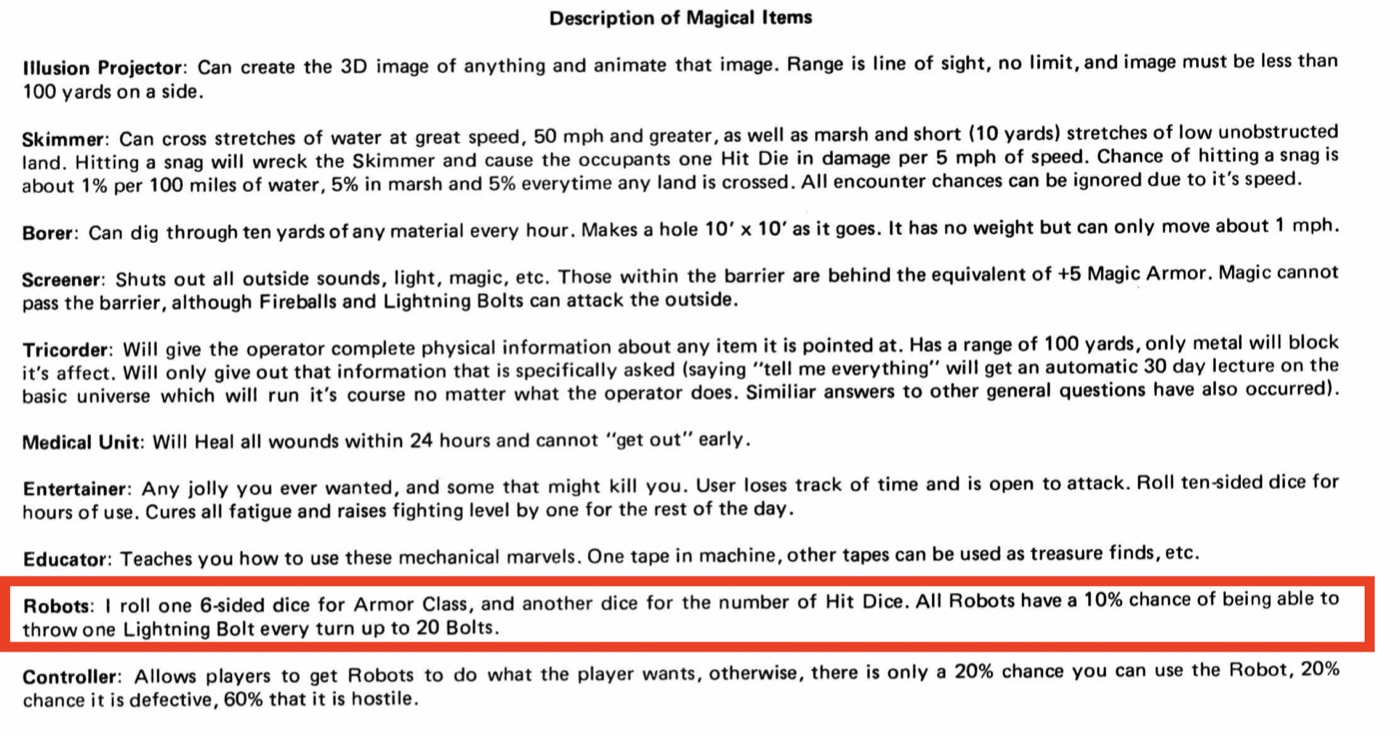
Wait, what does that mean? Should we assume this means a value from AC1 to AC6?
Or does this mean that the Robot has the equivalent of one of these:
- Plate + shield
- Plate
- Chain + shield
- Chainmail
- Leather + shield
- Leather
- Shield only
- Unarmored
That’s 8 values. But the Robot can only have 6 of these. If you assume a linear progression, perhaps the Robot only has the first 6 of these, as we can assume it has a metallic body and is thus at least the equivalent of leather.
Doing another query against all of the monsters, we can see that there are clearly some of them with AC1 by looking at p. 31 describing how the 3rd level of Blackmoor’s dungeon is populated. There are numerous mentions of AC 1. This cannot be a typo.
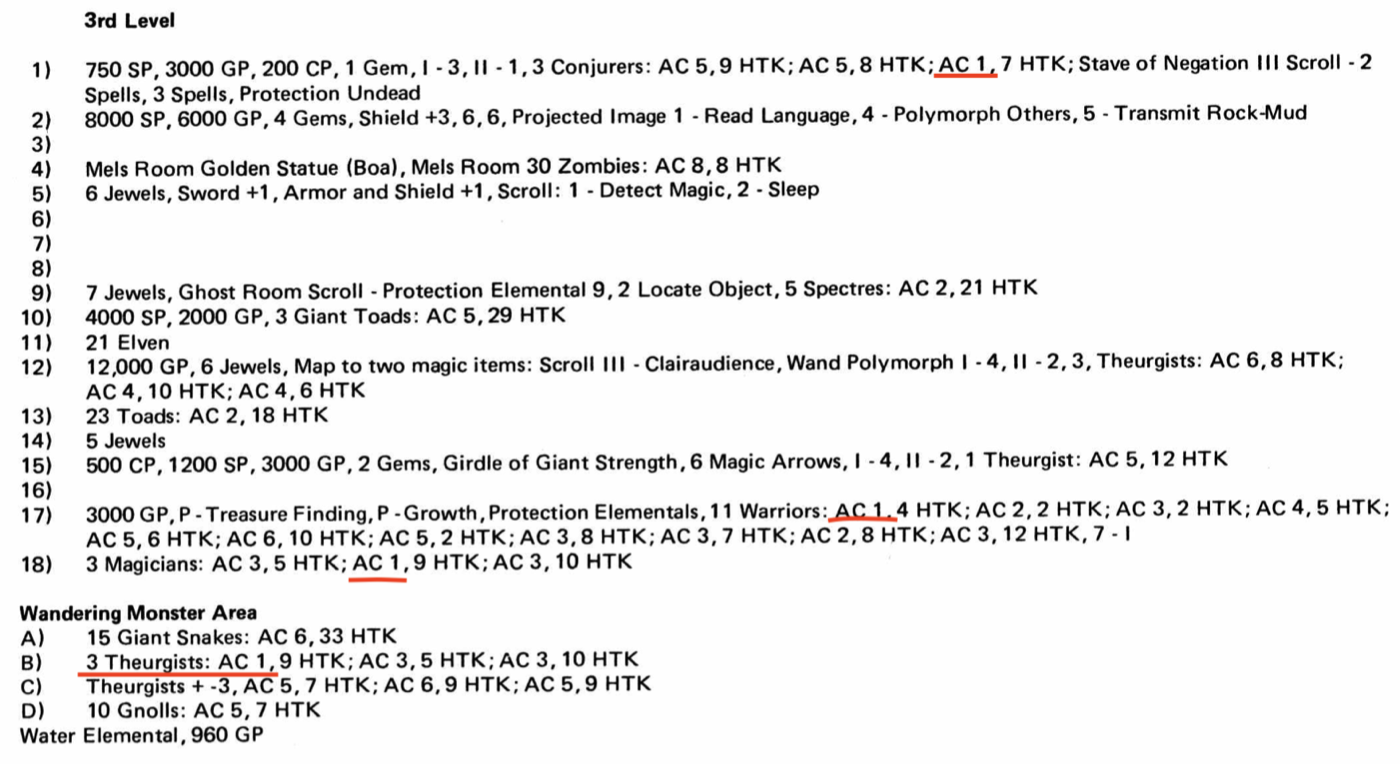
Further analysis of Blackmoor’s monsters gives us the full story. The two classes of characters and NPCs (Warriors and Magic-Users) are much like the Robot: when encountered in the dungeon their armor class varies between AC1 (first class armor) and AC6.
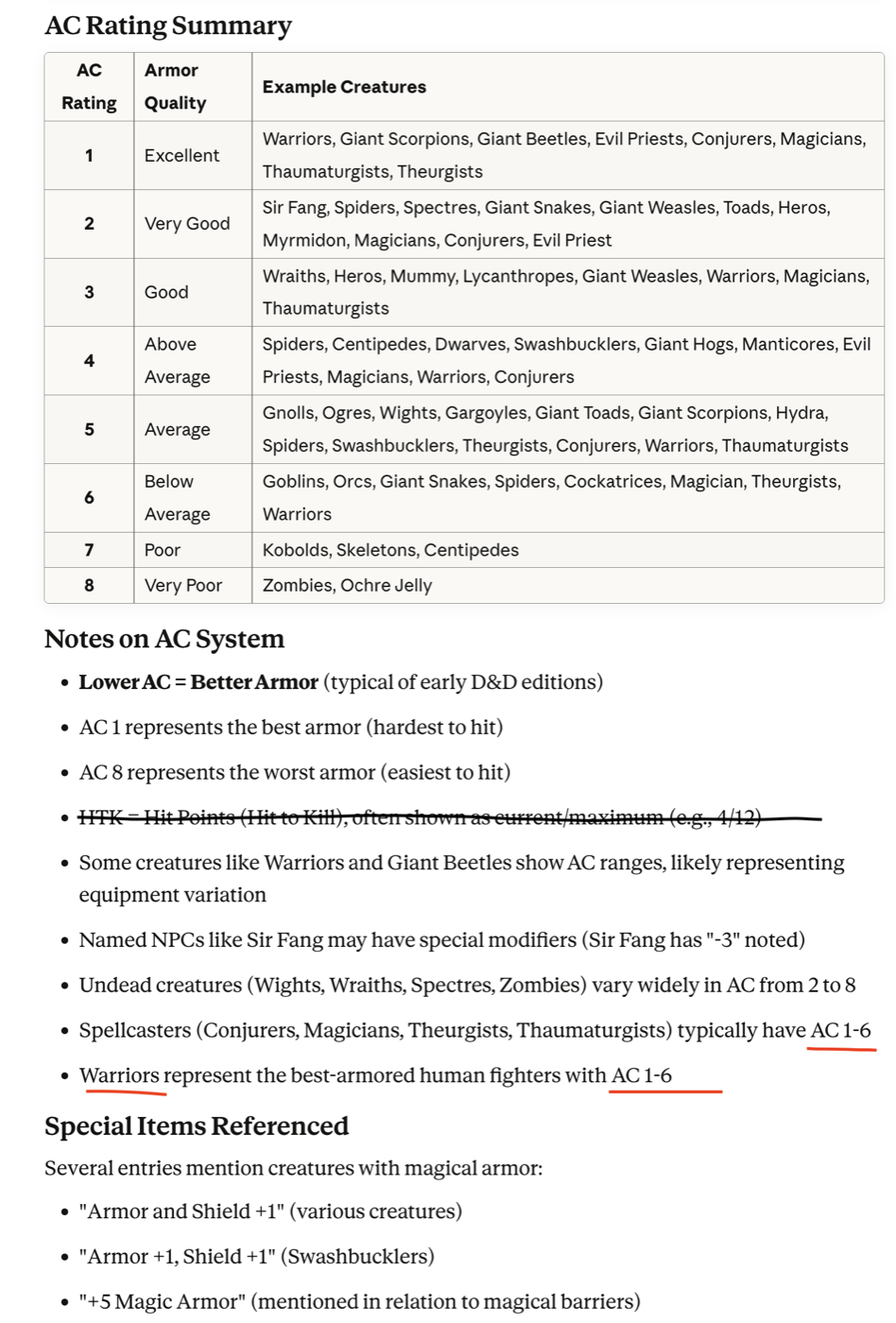
Without going down the rabbit hole of why Magic-Users can achieve the best armor class at fairly low levels of experience, let’s stick with the combat system.
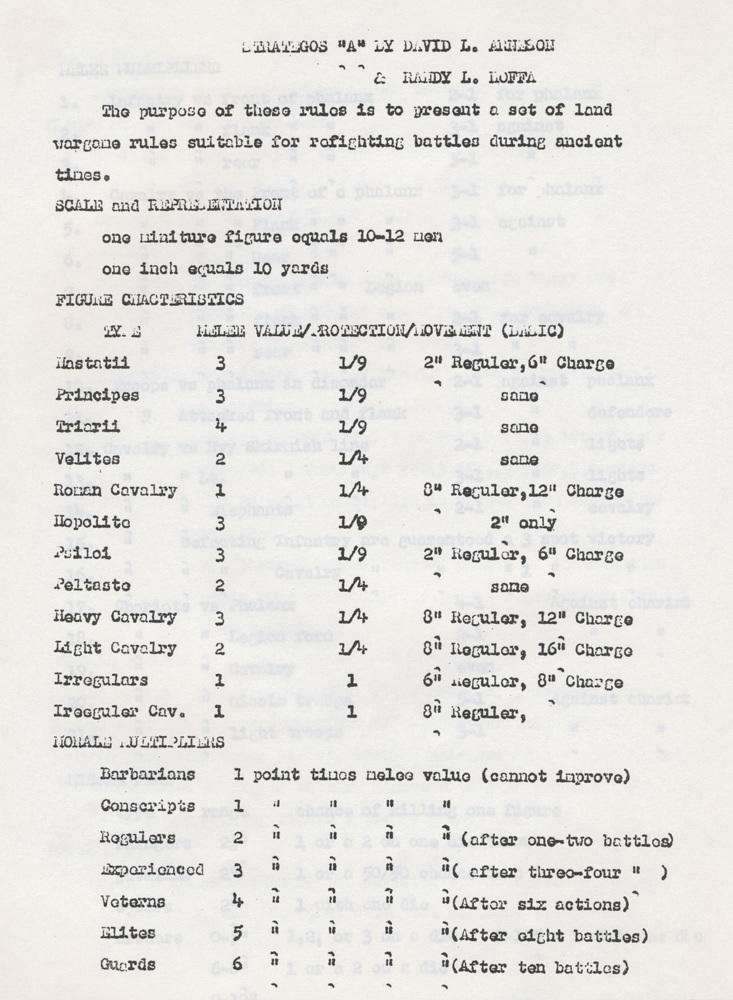
I’m going to shift gears and talk about Strategos A for a moment. Strategos A was written by Arneson and Randy Hoffa to cover ancient warfare. It was adapted from Charles Totten’s Strategos and related to Strategos N which is the Napoleonic set of rules used by the Twin Cities gamers and devised by David Wesely.
In Strategos A there are 3 different “protection” values listed: 1, 1/4, 1/9. Totten’s Strategos uses a lot of ratios so the denominators here are 1, 4, and 9. The heavier troops do tend to get the 1/9 multiplier with the exception of Psiloi which were light troops who skirmished so the 1/9 multiplier is probably due to their dispersion on the battlefield.
We know Dave Arneson had access to the 1st edition of Chainmail (published March 1971). As a matter of fact he tells us this at the top of p. 30 of FFC.

What can that tell us about armor? It’s not like 1st edition is readily available. What we do know from looking at Domesday #5 (published 1 July 1970) with the LGTSA miniature rules is 1) the man-to-man tables are missing for melee and individual missile fire and 2) the only real mention of armor is in the mass combat missile table which provides, again, only 3 classes of protection.
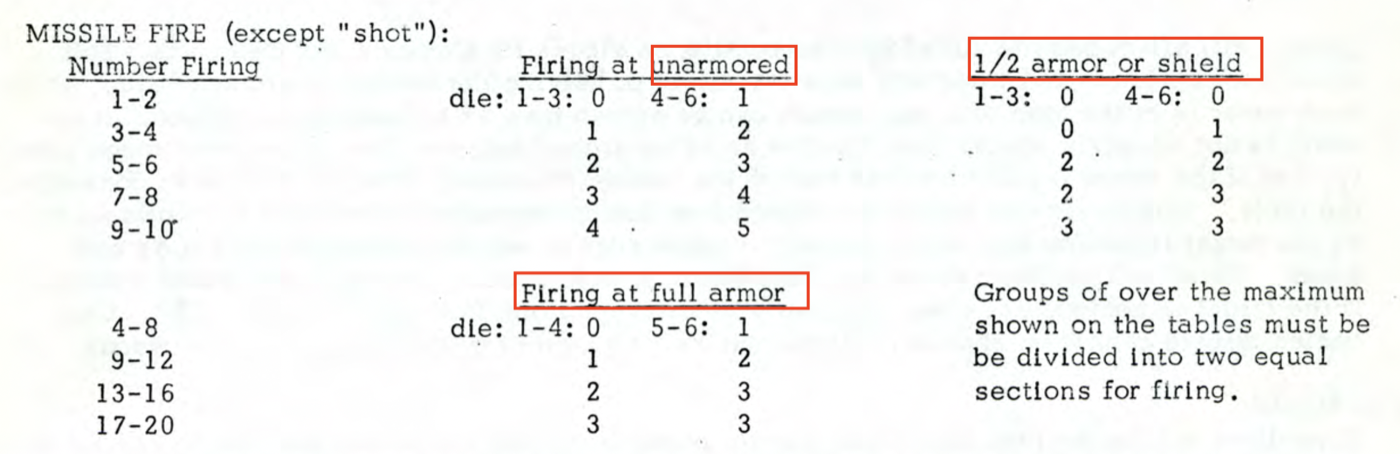
Jon Peterson obviously has access to Chainmail 1st edition, but has only published a portion. The individual missile fire table which Gary Gygax published “in the August 1971 issue of the International Wargamer (about four months after first edition Chainmail)” would later make an appearance in the second edition of Chainmail. So we can toss that out although it is interesting to note that Gygax had Armor Classes in 8 categories with the most protective listed as the eighth. See http://playingattheworld.blogspot.com/2012/10/armor-class-in-chainmail.html.
The man-to-man melee table is cut off at the right edge (thanks Jon, helpful as ever!). So we can’t tell what the complete table looked like.
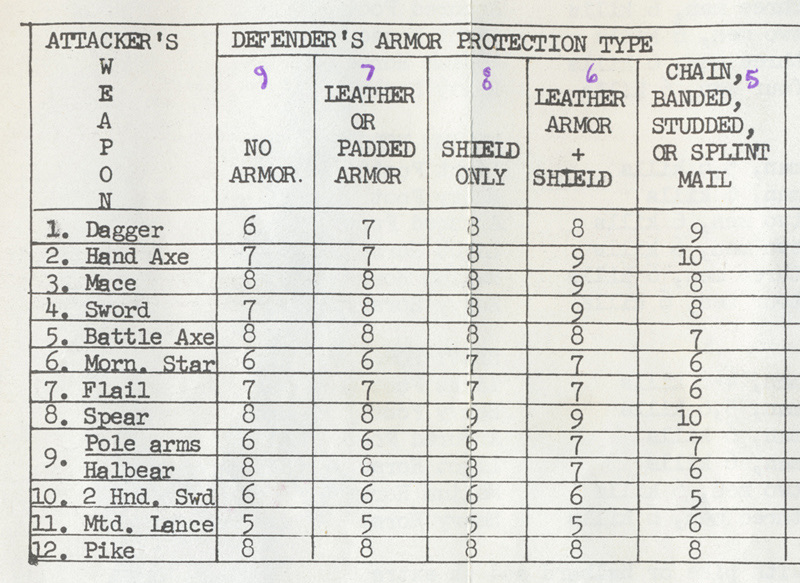
[The other thing to note is that Gygax did not add the parry rules until the second edition of Chainmail either. Parrying is not mentioned in Arneson & Snider’s Adventures in Fantasy (though dual wielding a dagger does make an appearance).]
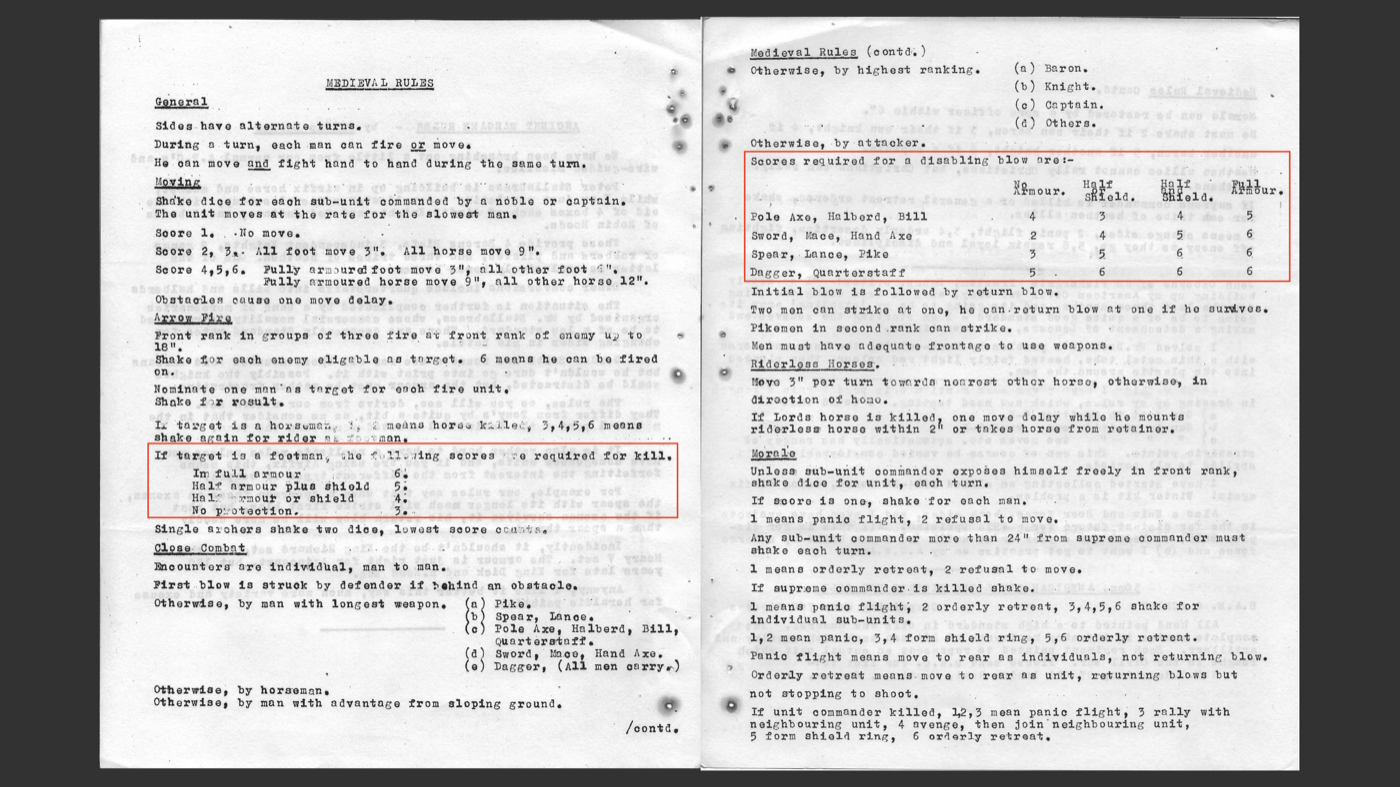
We do know that the precursor to Chainmail’s man-to-man table actually originated out of England via the Featherstone and Phil Barker wargaming scene. The picture below is from Wargamer’s Newsletter issue 51 from June 1966. This made its way to the American side of the ocean as Peterson describes on his blog. There are 4 categories of protection.
At the risk of being pedantic, it isn’t hard to understand how Arneson may have independently arrived at his own system of armor with 8 categories once he landed on 3 types of armor plus a shield for added protection.
As the story goes, Arneson was also looking at naval warfare rules, specifically Fletcher Pratt’s rules and a set of rules for the American Civil War. Fletcher Pratt’s rules are credited with giving Arneson the inspiration for hit points (aka “hits to kill” / HTK). But there is one chart that also encapsulates the offensive value (caliber) versus defensive value (inches of armor) with the added complexity of diminishing penetration as range increased. Yet, these variables seem to have a (mostly) linear relationship with one another.
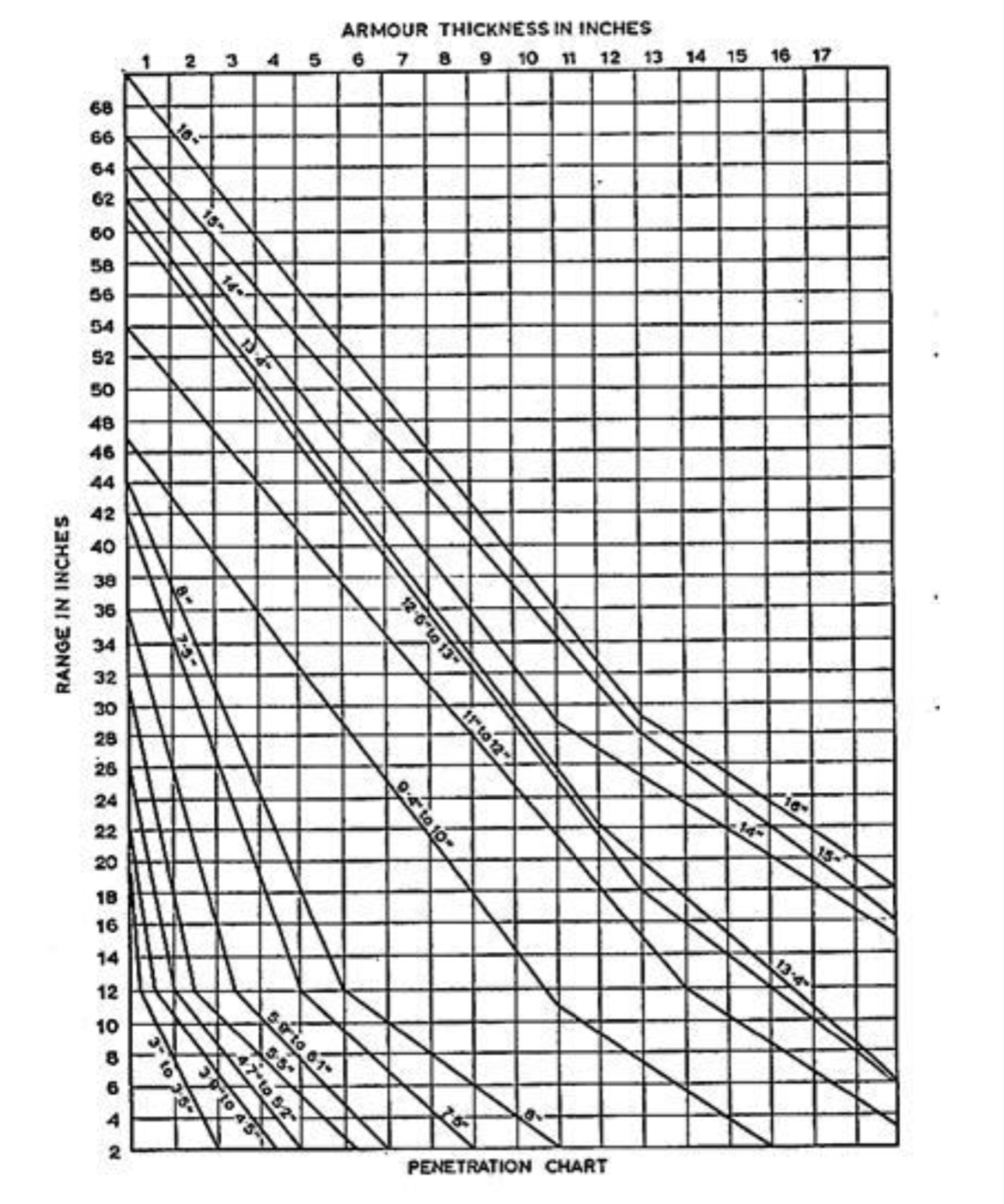
Pratt’s rules have additional special effects for hitting various parts of the ship such as gun turrets (versus deck hits and belt hits). We see hit location show up again in the aerial combat rules in OD&D LBB#3 p. 27, Don’t Give Up the Ship (high mast / sail damage versus low damage to sink the ship) and Book V: Blackmoor. DGUTS 1st edition was published in 1972.
In Part 2 - I will tackle the attacker and circle back to the defender
In Part 3 - I will look at additional complexities that may have been present
and in Part 4, I will conclude this series with a reconstructed technique for combat
Originally published on Substack on November 16, 2025.